Upskilling helps someone get better at the job they already do. Reskilling prepares them for a different job altogether.
In my experience, most organisations need both. What they often lack is a clear way to decide who needs which, and when. That’s what this post is about.
Key Points:
- Upskilling builds on someone’s current role so they can do it better
- Reskilling prepares someone for a different role, often because their current one is changing or going
- Upskilling is usually quicker and cheaper; reskilling is a bigger investment with a bigger payoff
- AI is making the decision more urgent for almost every organisation
- Knowing your current skills is the starting point for both

What Is Upskilling?
Upskilling means teaching people new skills that help them perform better in their current role. The job stays the same. The way they do it improves.
A marketing executive learning to use AI tools for campaign analysis is upskilling. So is a team leader learning how to coach, or a finance analyst getting to grips with a new reporting system. They’re all building on what they already know.
Upskilling tends to be continuous. Roles change a little every year, and people need to keep pace.
What Is Reskilling?
Reskilling means training someone for a different role. It usually happens because their current job is changing so much that it’s effectively a new one, or because it’s disappearing altogether.
A customer service adviser moving into a data role is reskilling. So is a warehouse operative training as a maintenance engineer as automation takes over the picking. The person stays with the organisation, but what they do changes completely.
Reskilling is a bigger commitment. It takes longer, it needs more support and there’s more at stake for the individual.

Upskilling vs Reskilling: The Key Differences
- The goal. Upskilling improves performance in the current role. Reskilling prepares someone for a new one.
- The trigger. Upskilling is usually driven by a role evolving. Reskilling is usually driven by a role being replaced or a skills shortage elsewhere in the business.
- The timescale. Upskilling can happen in short bursts over weeks. Reskilling often takes months.
- The cost. Upskilling is cheaper per person. Reskilling costs more, but it’s often far cheaper than redundancy and rehiring.
- The risk. Upskilling is low risk. Reskilling asks more of the individual, so support and motivation matter a lot more.
When Upskilling Is the Right Call
Upskilling makes sense when the role is staying but the skills it needs are shifting. That covers most people in most organisations, most of the time.
Typical signs you need to upskill:
- New tools or systems are being introduced
- Performance expectations in a role have gone up
- People are being promoted into management for the first time
- Customers are asking for things your team can’t yet deliver
Upskilling works best when it’s little and often, and when people can use what they learn straight away. That’s why microlearning is such a good fit. Short pieces of learning that fit around the working day stick far better than a long session crammed with content.
When Reskilling Is the Right Call
Reskilling makes sense when a role is changing beyond recognition or going altogether, and you’d rather keep the person than lose them.
Typical signs you need to reskill:
- Automation or AI is taking over most of the tasks in a role
- You’re struggling to hire for skills you need, while other roles are shrinking
- A restructure is creating new roles and removing others
- Long-serving people have deep knowledge of your business that you don’t want to lose
That last point is the one I’d push hardest. Someone who already understands your customers, your culture and your processes has a huge head start in a new role. Hiring from outside means paying to replace all of that.
Why Most Organisations Need Both
The World Economic Forum expects 39% of workers’ core skills to change by 2030. That’s a big shift for any workforce. Some of your people will need to grow with their roles. Others will need to move into new ones.
You need to plan for both. Upskilling keeps your current workforce sharp. Reskilling gives you a pipeline of people for the roles you’ll need in future.
AI Is Forcing the Question
If there’s one thing pushing organisations to think about this now, it’s AI. Almost every role will be affected in some way. For most people, that means upskilling. They’ll keep their job but do it differently. For some, the changes will be big enough that reskilling is the honest answer.
The trouble is that most organisations don’t know where they stand. They haven’t mapped which roles are changing, how ready their people are or where the biggest gaps sit. Without that, it’s very hard to decide who needs what.
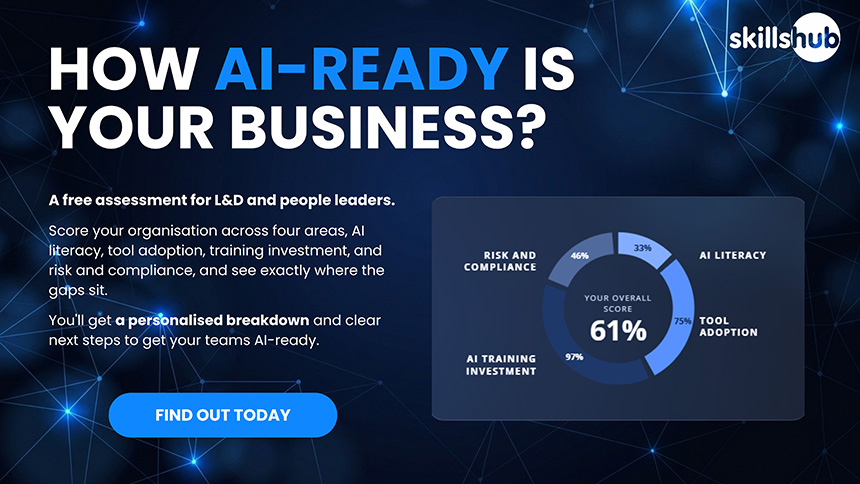
Our AI Readiness Assessment was designed for exactly this. It gives you a clear picture of where your organisation is today, so you can decide where upskilling will do the job and where you need to think bigger.
The Benefits of Upskilling Employees
Upskilling gets less attention than it deserves because it’s less dramatic than a big reskilling programme. The benefits of training the people you already have add up quickly though.
- People stay longer. In TalentLMS research, 73% of employees said better learning and development opportunities would make them stay with their employer for longer.
- It’s cheaper than hiring. Developing someone you already have avoids recruitment costs and the time it takes a new starter to get up to speed.
- Performance improves. People who are confident in their skills do better work.
- You’re more adaptable. A workforce used to learning copes far better with change.
How to Upskill Your Workforce
1. Find out where you are now
You can’t close a gap you haven’t measured. Look at the skills each role needs now and in the near future, and compare them with what your people have.
2. Set clear outcomes
Decide what people should be able to do differently once the learning is done. Our guide to writing learning objectives is a useful place to start.
3. Build learning into the working week
Most upskilling happens on the job, so formal training is only part of the picture. Give people the chance to practise, get feedback and learn from colleagues.
4. Make it hands-on
People learn new skills by using them. Build in scenarios, practice tasks and real projects so they can try things out before it counts. A blended learning approach, mixing hands-on practice with short online content, suits most upskilling well.
5. Measure the difference
Track whether behaviour and performance change. Completion rates on their own won’t tell you much.

How to Run a Reskilling Programme Well
Reskilling needs everything above, plus a bit more care. A few things I’d always build in:
- Be honest early. People cope far better with change when they’re told the truth about their role in good time.
- Choose people carefully. Look for transferable skills and a real interest in the new role. Motivation matters more here than almost anywhere.
- Give it time. Reskilling won’t happen in a fortnight. Plan for months, with clear milestones written into each person’s development plan.
- Support people properly. Mentors, coaching and a safe space to make mistakes all make a big difference.
Upskill and Reskill Your Workforce with Skillshub
Whether you’re helping people grow in their current roles or preparing them for new ones, our course library has the content to support it, including practical AI courses that help people build confidence with the tools that are changing their work. If you’d like to see how it works, book a free demo.
If AI is the reason you’re thinking about this, start with the assessment. It’ll show you where your people stand and where to focus first.