Every organisation I speak to at the moment is talking about AI. Most have bought something, or are about to. Very few can tell me how ready their people are to use it.
That’s the gap. AI readiness is how prepared your organisation is to use AI well, and the technology is the easy bit. The harder part is whether your people have the skills, whether your leaders know what they want from it, whether there are sensible rules in place and whether your culture lets people try something new without worrying about getting it wrong.
Most of that lands on L&D. So I’ve put together a quick checklist to help you spot where you might be falling short. It’ll show you what’s missing. To see how ready you are and where to start, you’ll need more than a checklist, and I’ll come to that.
Key Points:
- AI readiness depends on people and culture as much as technology
- Most readiness gaps are skills and confidence gaps, which puts L&D at the centre
- The checklist covers six areas, from strategy through to measurement
- A checklist shows you what’s missing, but not how far behind you are or what to fix first
- Our free AI Readiness Assessment scores each area so you know where to focus
What Does AI Readiness Mean?
AI readiness is a measure of whether your organisation has the foundations in place to adopt AI successfully. A decent AI readiness framework looks at several areas side by side, because a weakness in one can undo a strength in another.
I’ve seen businesses with brilliant tools and no guidance on how to use them. The results are all over the place and the risks are real. I’ve also seen businesses with a beautifully written AI policy and no training to back it up. Either nobody touches the tools, or they use them badly.
Being AI-ready means people understand what AI can do in their role, feel confident using the tools they’ve been given and know where the lines are. Most teams can get there without anyone becoming an expert. Getting there takes the same training strategies that work for any new skill.
Why L&D Should Lead on AI Readiness
AI often gets treated as an IT project. IT has a big part to play in choosing tools and keeping them secure, but the things that slow adoption down are almost always people problems. People aren’t sure what they’re allowed to do. They’re worried about getting it wrong. They don’t know how to check whether an answer is any good.
Those are learning problems, and L&D is the team best placed to solve them. If AI isn’t part of your learning and development strategy yet, now’s the time to change that.
The AI Readiness Checklist
Go through each question and answer yes or no. Be honest with yourself. Every “no” is a gap.
1. Strategy and leadership
- Can your leaders explain why you’re using AI and what it should achieve?
- Have you agreed a small number of priority use cases?
- Does someone senior own AI adoption?
- Is L&D involved in AI planning before any tools are chosen?
2. Tools and data
- Do employees know which AI tools they’re allowed to use at work?
- Is there clear guidance on what data can and can’t go into AI tools?
- Have IT and L&D agreed how new tools will be introduced and supported?
3. Skills and capability
This is where most organisations have the biggest gaps. People build AI skills by using the tools, so hands-on, active learning strategies will do far more here than a slide deck explaining what AI is.
- Do you know the current level of AI skills across different teams?
- Is basic AI awareness training available to everyone?
- Are people shown how to check AI output for accuracy and bias?
- Are managers equipped to support their teams as they learn?
4. Culture and confidence
Most AI learning happens on the job, as people try tools in their own work and swap notes with colleagues. The 70/20/10 model is a good reminder of how much depends on what happens outside the training itself.
- Do people feel able to experiment with AI without fear of getting it wrong?
- Are worries about AI and job security talked about openly?
- Do your leaders use AI themselves and talk about how they use it?

5. Governance and ethics
- Is there a written AI policy that people have read and understood?
- Does it cover data protection, confidentiality and intellectual property?
- Do people know who to ask if they’re not sure whether something is allowed?
6. Measurement
Measurement tends to get left until last, which makes progress almost impossible to prove. AI adoption deserves a place alongside your other learning and development KPIs.
- Have you agreed what success looks like for AI adoption?
- Do you track how the approved tools are being used?
- Can you link AI training to changes in how people work?
What a Checklist Can’t Tell You
If you answered no to a few of those, you’re in good company. Most of the L&D teams I talk to would too.
The trouble with a checklist is that it only gives you a list of gaps. It can’t tell you how far behind you are in each area, which gaps are holding you back the most or where you should start.
Two organisations can tick exactly the same boxes and be in completely different places. One might have strong backing from the top and simply need to train people. The other might have the training sorted but a culture where nobody feels safe trying anything new. Same checklist, very different fixes.
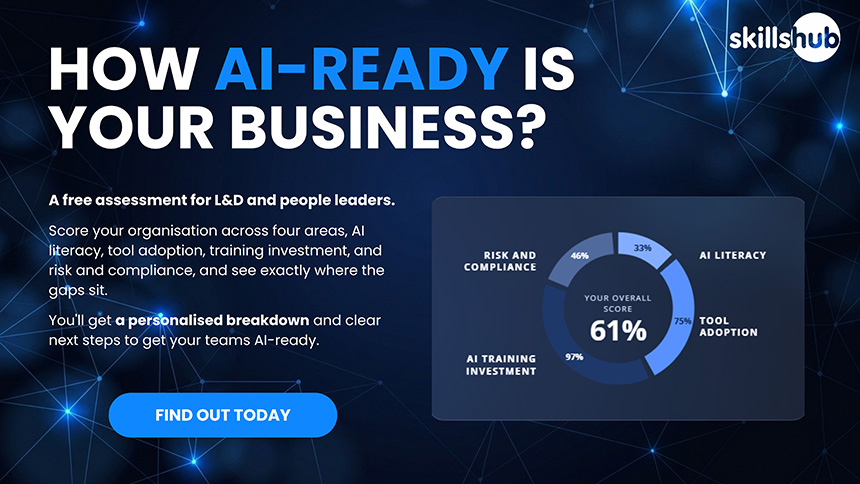
That’s why we built our AI Readiness Assessment. It takes a few minutes, scores your organisation across each area of readiness and shows you where to focus first. You come away with a plan built on evidence instead of a hunch.
Closing the AI Skills Gap with Skillshub
Once you know where the gaps are, you need the right learning to close them. Our course library includes AI content built to give people practical skills and the confidence to use them, from their first steps with AI tools through to using them responsibly at work.
It all sits on one learning platform, so you can roll AI training out across the business, assign it by team and track progress against the gaps your assessment picked up.
AI skills needs vary a lot from role to role, so it’s worth tailoring what you offer. Our article on how personalised learning with AI predicts engagement goes into how to make sure learning lands with each group.