
So, what are the top elearning trends for 2026? The world of workplace learning is shifting faster than most L&D departments can keep up with. Technology is evolving, employee expectations are changing and the pressure to show measurable performance improvement is higher than it has ever been. What worked even two or three years ago now feels slow, clunky or outdated compared to what employees experience in the apps and tools they use every day.
In my experience, the organisations that stay ahead are the ones that adapt early. They simplify. They modernise. They build learning ecosystems that employees actually want to use.
eLearning in 2026 will look very different from the corporate learning of the past. It will be more personalised, more integrated into the workflow and far more focused on real behaviour change.
These topics reflect the shifts already happening inside forward-thinking organisations and the technologies that will soon become standard.
2026 eLearning Trends:
- AI generated learning paths become the standard
- Custom GPTs created to help staff learn in the flow of work
- AI tutors replace first line support in L&D
- Learning moves directly into the workflow
- The end of overlong LMS systems
- Personalised content replaces generic libraries
- Skills based learning replaces competency frameworks
- AI driven content repurposing takes over production
- Managers become co-creators of learning, not just consumers
- Mobile first learning finally overtakes desktop
- AI powered coaching for everyone, not just leaders
- Learning becomes fully on demand and employee controlled
These trends are not theoretical. They reflect what is already happening inside organisations that treat learning as a performance tool, not an event. They also highlight where L&D teams will need to shift their mindset if they want to stay relevant in a workplace where technology is advancing at pace.
Let’s explore the first four trends shaping eLearning in 2026.
Trend 1: AI generated learning paths become the standard
For years, L&D teams have tried to personalise learning by hand, matching content to roles, goals and skill gaps. It has always been a slow and manual process. In 2026, that changes completely. AI now has the ability to analyse job roles, performance data and learner behaviour to automatically create tailored learning paths that are far more accurate than anything built manually.
This is not about sending people recommended videos based on what they clicked last week. It is about generating complete development journeys that respond to how the individual performs over time. If someone struggles with delegation, the system adapts. If they progress quickly, it accelerates their path. If a role changes, the learning updates instantly.
This level of precision will become the new expectation. Employees want learning that feels relevant and timely. Leaders want learning that supports actual performance. AI generated pathways give both sides what they need. For L&D teams, the benefit is huge. Instead of spending hundreds of hours curating content, they can focus on coaching, strategy and aligning learning with business priorities.
Platforms like ours have already worked on features that move in this direction. The demand now is for every organisation to embrace adaptive learning as the baseline, not the bonus. You can see how we approach this as an eLearning company that focuses on speed, relevance and genuine behaviour change rather than traditional one size fits all learning.
Trend 2: Custom GPTs created to help staff learn in the flow of work
This trend is going to be one of the biggest shifts of 2026. Employees increasingly expect instant answers when they are stuck. They no longer want to search through long courses or heavy resource libraries. They want something that behaves like a personal learning assistant, one they can ask questions to in plain English.
Custom GPTs make this possible. A learner can ask, “How do I handle this type of customer objection?” or “Can you break down how to complete this process?” or “Show me how to prepare for a difficult conversation.” The AI can respond with guidance, examples, scripts or a step by step method based on the organisation’s own best practices.
This changes the relationship people have with learning. It stops being something they schedule. It becomes something they use in the moment, just like messaging a colleague. It also removes friction. There is no login journey, no searching through folders and no long videos to scrub through. Just a question and an answer when the person needs it.
L&D teams should not fear this. It does not replace training. It enhances it. Custom GPTs give people confidence in real time while traditional development activities build deeper capability over time. Together, they create a learning environment where support is always available, not dependent on diaries or formal workshops.
The organisations already adopting this are seeing stronger uptake of learning because the barrier to access is so low. It is one of the clearest signs of where digital learning is heading.
I have written a guide on this shift called How Can Personalised Learning with AI Predict Engagement?, which breaks down how AI generated paths can drive stronger uptake and real behaviour change.


Trend 3: AI tutors replace first line support in L&D
In many organisations, L&D functions get overwhelmed with basic questions. Employees ask where to find a policy, how to complete a form or which course would suit their development goal. These questions interrupt the strategic work L&D wants to focus on. AI tutors solve this problem.
AI tutors can handle repetitive queries instantly. They can recommend content, explain processes and offer on demand coaching prompts. They are available twenty four hours a day and never get overloaded. This means L&D teams can redirect their time toward more strategic initiatives such as developing future capability, working with leaders and ensuring learning aligns with business performance.
There is another benefit. Employees gain confidence because they can ask questions they might hesitate to raise with a colleague. They can practise scenarios privately. They can get guidance without booking time with someone. AI tutors democratise support. They make learning accessible to everyone, not just those who actively seek development.
In 2026, most organisations will adopt some form of AI tutoring. It will become a standard part of digital learning ecosystems. The organisations that move early will gain a clear advantage because learners become more self-sufficient and more engaged in their development.
Trend 4: Learning moves directly into the workflow
One of the biggest issues in learning has always been the gap between training and application. People attend courses, take notes and then return to work where habits, pressures and old routines quickly take over. Learning fades because the environment does not support it.
Workplace learning in 2026 moves directly into the workflow. The most progressive organisations already design learning to appear inside the tools employees use every day.
Instead of asking people to go to a separate platform, learning appears at the moment of need, inside their workflow, during a task or immediately after a challenge arises.
This trend is powerful because it aligns development with the reality of how people work. Short prompts, short micro sessions and short AI coaching nudges become the norm. Employees get only what they need and only when they need it. Learning becomes something people do naturally rather than something they have to schedule.
When learning blends into the workflow, behaviour change increases significantly. People act on the guidance straight away rather than relying on memory weeks later. This is the shift L&D leaders have been waiting for. It finally closes the gap between theory and application.
Trend 5: The end of overlong LMS systems
For more than twenty years, the LMS has been the centrepiece of most corporate learning strategies. The problem is that traditional LMS platforms have become slow, heavy and exhausting to navigate. They were built for administration rather than learning. In 2026, that becomes impossible to ignore.
Employees no longer accept outdated platforms that require long navigation paths, multiple clicks and complicated folder structures. They expect simple, intuitive, mobile first learning environments. Modern teams respond far better to an eLearning platform designed for speed and ease of use rather than traditional LMS structures. They expect tools that feel modern and align with the consumer grade experiences they use everywhere else in their lives.
The shift away from traditional LMS systems is already happening inside leaner, more agile organisations. Instead of one giant platform, they use lightweight learning tools, content hubs and workflow based learning integrations. The purpose of the learning platform changes from housing content to helping people solve problems quickly.
This trend is not about removing structure. It is about removing friction. Learning is only valuable if people actually use it. In 2026, the platform itself will become part of the learning experience. If it slows people down, the learning dies. If it speeds them up, behaviour change increases.
Platforms like ours have already embraced this direction for years, and it is clear that L&D teams are now prioritising simplicity as strongly as content quality.
If you are comparing vendors, we have reviewed The Best eLearning Platforms in the UK to help L&D teams understand what good looks like now.
Trend 6: Personalised content replaces generic libraries
For years, organisations have invested in huge eLearning libraries, often containing hundreds or thousands of resources. These libraries often look impressive at first glance. The reality is that most employees only engage with a tiny fraction of them. Generic content feels distant. It lacks relevance. It does not reflect the day to day challenges people experience at work.
In 2026, personalised content will become the new expectation. People want learning that speaks directly to their world. They want examples that feel familiar. They want scenarios that match their job, not someone else’s. This is where AI and adaptive learning combine to create far more meaningful digital experiences.
Personalised content acts almost like a conversation. It adjusts based on what the learner knows, how they behave and what they need next. Instead of forcing everyone through the same material, the system adapts. This level of relevance dramatically increases engagement because it treats the learner as an individual rather than part of a crowd. It is also why more organisations are investing in eLearning content that can be shaped around specific roles and real workplace scenarios.
L&D teams also benefit because personalised content reduces waste. Instead of paying for enormous libraries that nobody uses, they invest in targeted learning that actually drives improvement. The organisations that embrace this shift will create stronger learning cultures because people stop seeing learning as a requirement and start seeing it as support.
Trend 7: Skills based learning replaces competency frameworks
Competency frameworks have been the backbone of corporate learning for decades. The problem is that they move too slowly for the modern workplace. Jobs evolve faster than competencies can be rewritten. Teams change structure. Technology changes expectations. Competency frameworks often end up describing the past rather than preparing people for the future.
Skills based learning solves this problem. Instead of focusing on broad, static categories, organisations break roles into the specific skills required to perform successfully. It becomes easier to diagnose gaps, design learning around them and measure improvement in a clear way.
Skills based learning also supports internal mobility. When people are hired or promoted based on proven skills rather than abstract competency statements, the organisation becomes more adaptable. Employees can move between teams more easily. Talent pipelines improve. Development becomes practical rather than theoretical.
In 2026, this shift gains real momentum. More organisations will reframe development around observable skills and behaviours. It aligns neatly with the direction of AI driven learning paths because it creates a structure the technology can work with. Skills are measurable. Competencies rarely are. Many teams also move toward bespoke eLearning at this stage because it allows the content to reflect the exact skills and behaviours their people need. The organisations that embrace this shift will be better equipped to build future capability.
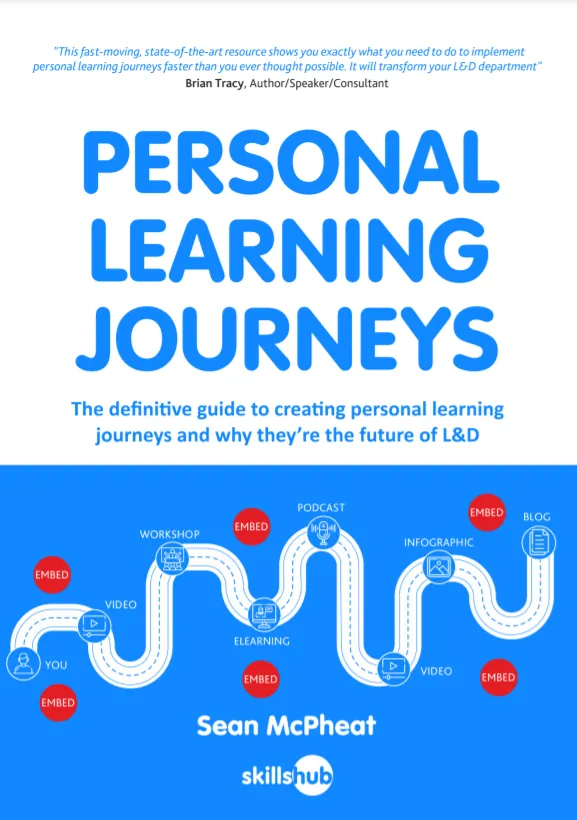
Learn How To Create Personal Learning Journeys For FREE!
Trend 8: AI driven content repurposing takes over production
Creating digital learning content has always been a time consuming process. A trainer records a video, then someone edits it, writes scripts, designs slides and produces supporting materials. The content creation process often takes longer than the actual learning itself. In 2026, AI changes this completely.
AI tools can now take a single piece of content and instantly repurpose it into multiple formats. Video becomes microlearning sessions, written summaries, scenario examples, step by step checklists and coaching prompts. One source of truth becomes a full suite of resources that support learning in different moments and for different types of learners.
This shift does not just save time. It increases the consistency of learning across the organisation. Everyone receives the same message, the same terminology and the same method, even if they prefer different formats. It also frees L&D teams from spending endless hours on manual production so they can focus on higher level strategy.
This trend accelerates the speed at which organisations can respond to change. When new processes, products or strategies are introduced, learning content can be created and repurposed in hours rather than weeks. In a world where change is constant, this agility becomes a competitive advantage.
Trend 9: Managers become co creators of learning, not just consumers
Managers have always played an important role in learning. They reinforce behaviours, support development and hold people accountable. What has been missing is their involvement in creating learning itself. AI now makes it possible for managers to become active contributors rather than passive supporters.
In 2026, managers will be able to generate tailored content for their teams using simple prompts. They can create scenarios based on real challenges, produce quick how to guides, build onboarding resources or design practice conversations for new starters. They do not need technical expertise. They just need their own experience.
This shift is powerful because managers understand context better than anyone. They know what their teams struggle with. They know the language their organisation uses. They know the behaviours that need to change. When managers contribute to learning design, content becomes significantly more relevant and credible.
L&D teams will play a new role here. Instead of owning all content production, they become curators and quality controllers. They guide managers toward best practice, ensure standards remain high and integrate manager created content into wider learning journeys.
This trend creates a learning culture where everyone contributes. It removes the bottleneck on L&D and makes learning a shared responsibility rather than a department led activity.
Trend 10: Mobile first learning finally overtakes desktop
For years, L&D teams have claimed that mobile learning is the future, yet most corporate learning experiences are still designed for desktop. Courses are wide, navigation is clunky and videos are created with the assumption that learners are sitting at a desk with headphones on. That is not how most people learn anymore.
In 2026, mobile learning will become the dominant mode of consumption. Employees use their phones to learn because it fits the rhythm of modern work. They learn while commuting, between meetings, during short breaks or at home in the evening. They choose whatever device is closest to them, not the one the organisation prefers.
This shift puts pressure on L&D teams to redesign learning with mobile in mind from the very beginning. It is not enough to make courses responsive. They need to be intentionally designed for small screens, short attention spans and quick bursts of learning. Micro videos, short scripts, swipe based learning and AI driven prompts all lend themselves naturally to mobile formats.
When learning works seamlessly on mobile, usage increases. People engage more consistently because learning becomes something they can do anywhere. This trend rewards simplicity. It rewards clarity. It rewards learning that fits into the flow of real life, not just the workday.
The caveat around this is that your content MUST be geared for mobile consumption. If not, your people will have no other choice to click “next slide” on their normal desktop elearning course.
Trend 11: AI powered coaching for everyone, not just leaders
For decades, coaching has been reserved for senior leaders, high potentials or people in performance trouble. Coaching has always been valuable, but it has also been expensive and limited. AI changes the economics completely. Coaching is no longer a privilege. It becomes something every employee can access whenever they need support.
AI coaching tools can simulate conversations, ask powerful questions, help employees reflect on behaviour and offer guidance based on real challenges. They can support someone preparing for a difficult conversation, navigating a new role or practising a skill they have been taught. The AI is consistent, available anytime and designed to reinforce the behaviours the organisation wants to embed.
This does not mean human coaches disappear. In fact, it makes human coaching more effective because AI covers the day to day moments and humans can focus on deeper development. It also helps managers become better coaches because they see patterns in the questions employees ask and can tailor their support accordingly.
In 2026, coaching will become a normal part of everyday work. It is no longer a scheduled session. It is a resource people turn to as naturally as sending a message or searching online.
Organisations that embrace AI coaching will see capability improve faster and more consistently across the entire workforce.
Trend 12: Learning becomes fully on demand and employee controlled
One of the biggest mindset shifts in 2026 is the movement from L&D controlled learning to learner controlled learning. Employees want the freedom to choose what they learn, when they learn and how they learn. They are used to on demand content everywhere else in their lives, so anything that limits flexibility feels outdated.
This does not mean L&D loses control. It means they design systems that empower employees while still guiding them toward the behaviours and skills the organisation needs. The role of L&D becomes more about enabling access, curating high quality content and ensuring that learning is aligned with business performance.
On demand learning increases adoption because it respects people’s autonomy. It treats employees as adults who are capable of directing their own development. It also increases the likelihood that learning will translate into behaviour change because it happens at the moment of personal motivation, not the moment of organisational scheduling.
In 2026, organisations that embrace this approach will build stronger learning cultures. Employees will develop more proactively. Leaders will feel more supported. And L&D will move from being a provider of courses to being a strategic engine of performance.

What these trends mean for L&D teams in 2026
Individually, these trends are significant. Together, they represent a complete shift in how organisations think about learning. Learning becomes lighter, faster, more personal and far more integrated into the way people actually work. The days of long courses, complicated LMS systems and one size fits all content are disappearing.
In my experience, the organisations that will succeed in 2026 are the ones that understand these principles:
- Learning must be accessible. Learning must be relevant.
- Learning must be measurable. Learning must be embedded in the workflow.
- Learning must support behaviour change, not just course completion.
This is where digital learning is heading. It is practical, modern and designed around the learner, not the provider. Technology has finally caught up with the way people want to develop. The task now is for organisations to build learning ecosystems that support this reality.
Platforms like ours already operate in this direction. Flexible content, mobile first design, AI support and workflow integration are no longer features. They are expectations. Employees know what good learning looks like. They experience it everywhere else. It is now up to organisations to match that standard.
Preparing your organisation for the future of digital learning
The pace of change in workplace learning is only going to increase. The organisations that thrive will be the ones who treat learning as a performance tool rather than a content library.
They will simplify, personalise, integrate and modernise. They will give people the right support at the moment of need. And they will build learning ecosystems that genuinely improve how people work.
If you want to explore how this could look for your organisation, you can learn more about our eLearning solutions. Our approach is practical, workflow centred and designed to support real behaviour change where it matters most.
And if you are reviewing vendors at the moment, this guide on How to Choose the Right eLearning Provider will help you avoid the common mistakes organisations make.